Why Animal Calories Need More Land
Discover how the biology of farm animals creates an inefficient calorie pipeline that drives global deforestation.
When you walk through a grocery store, a kilogram of beef and a kilogram of lentils might sit just aisles apart. They look like equal choices on the shelf. But behind the scenes, one of those proteins required an enormous hidden pipeline of land, water, and crops just to reach its final size.
The physical footprint of our food system is heavily skewed by how farm animals grow.
Why does producing meat take up so much more land and water than growing vegetables?
The biology of feed conversion
Farm animals are living creatures, not perfectly efficient machines. Just like humans, they spend most of the energy they consume staying alive, breathing, and moving around, meaning they burn most plant calories rather than storing them as meat (WRI, 2019). The lost energy is released as metabolic heat, leaving only a fraction of the original crop calories behind in the animal's muscle.
If you feed a cow 100 calories of crops, you might only get back a few calories of beef. This biological bottleneck is called feed conversion efficiency, which measures how many units of plant feed it takes to produce one unit of animal food.
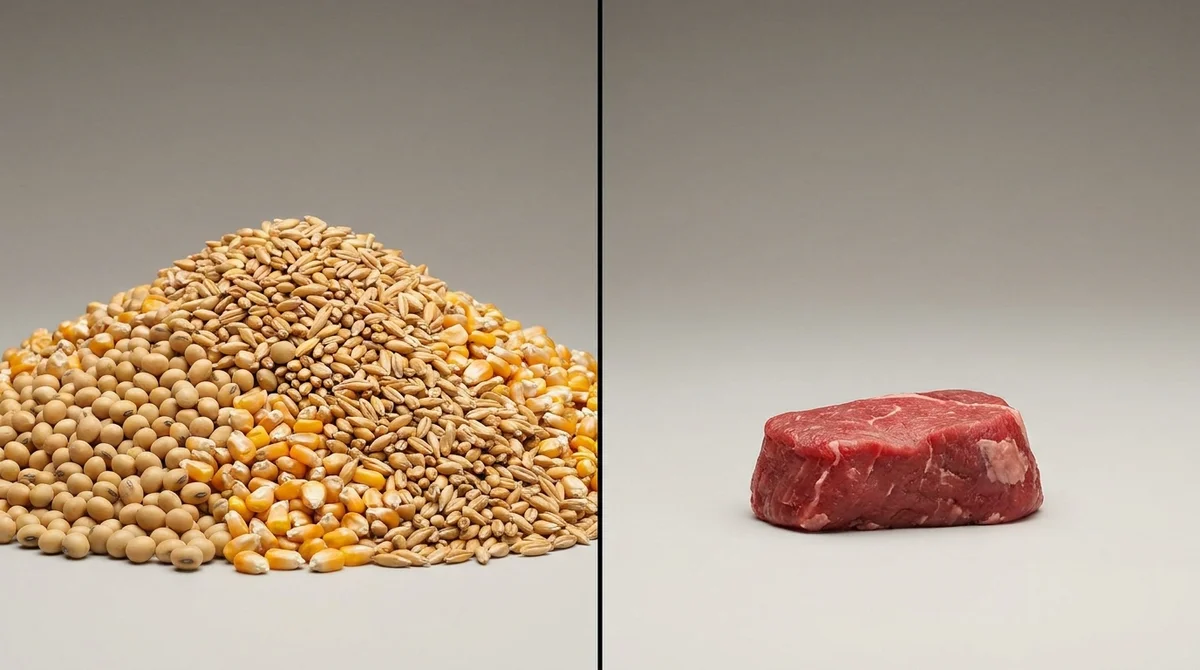
Because this ratio is so skewed, producing meat requires vastly more crops than if humans just ate plants directly. We essentially have to grow the food to feed the food.
The footprint of feeding livestock
To sustain billions of farm animals, agriculture requires staggering amounts of space. Because so much feed is required, rising demand drives rapid expansion, pushing farming into natural landscapes like forests.
This conversion of natural landscapes into agricultural fields is called land-use change. Nearly 80% of all global agricultural land is dedicated to raising livestock, either as pasture or as cropland to grow animal feed (Poore & Nemecek, 2018). Yet, meat and dairy provide less than 20% of the world's calorie supply.
This discrepancy brings up the soy deforestation myth, which is the mistaken belief that plant-based diets are driving rainforest destruction for tofu.
Fact: Over 75% of global soy production is processed into animal feed for poultry, pigs, and cattle. Only about 7% is used directly for human foods like tofu or soy milk.
When you replace meat with soy-based proteins, you actually reduce the total amount of soy that needs to be grown on your behalf.
Compounding resource intensity
The inefficiency of feeding animals multiplies every input required for farming. By adding a biological middleman, the entire supply chain scales up heavily, requiring far more water and fossil fuels per meal.
Resource intensity refers to the compound sum of land, water, and energy required to sustain a product before it reaches the consumer. For meat, this includes the water to irrigate the feed crops, the fuel for the tractors harvesting the feed, the transport to the animal farm, and the water the animals drink over months or years.
The total volume of freshwater used to produce a good is its water footprint, and beef's footprint is largely driven by its feed requirements (Water Calculator, 2011). Producing 1 kg (2.2 lb) of beef can require upward of 15,000 litres (3,962 gallons) of water. A comparable amount of plant protein, like lentils or peas, often requires less than a tenth of that water and a fraction of the land.
What to take away
The massive environmental footprint of meat comes down to basic biology, not just farming practices.
- Animals burn most of the calories they eat for daily energy, making them highly inefficient calorie converters.
- Growing crops to feed livestock requires vast amounts of land, driving global deforestation.
- Most soy grown globally goes to feeding farm animals, not to human foods like tofu.
Next, you will see how to apply this biological math to your own grocery budget by swapping out high-impact proteins.