
Desalination and Its Energy Trade-Offs
Evaluate the viability of manufacturing freshwater from the ocean and the profound environmental and geopolitical costs involved.
Our blue planet contains roughly 1.38 billion cubic kilometers of water, yet we face historic scarcity. From an engineering perspective, the solution seems obvious: just tap the ocean.
Since coastal megacities are often the hardest hit by depleting aquifers, pulling drinking water directly from the sea looks like the ultimate technological cheat code for human survival. In practice, manufacturing freshwater from seawater is one of the most expensive and energy-intensive industrial processes on Earth. It is not simply a matter of filtering out the salt and piping it to homes.
If the ocean is full of water, why don't we just remove the salt?
How manufacturing freshwater works
Modern plants do not simply boil water to catch the steam. Instead, they rely on complex membrane filtration to separate salt molecules from the water.
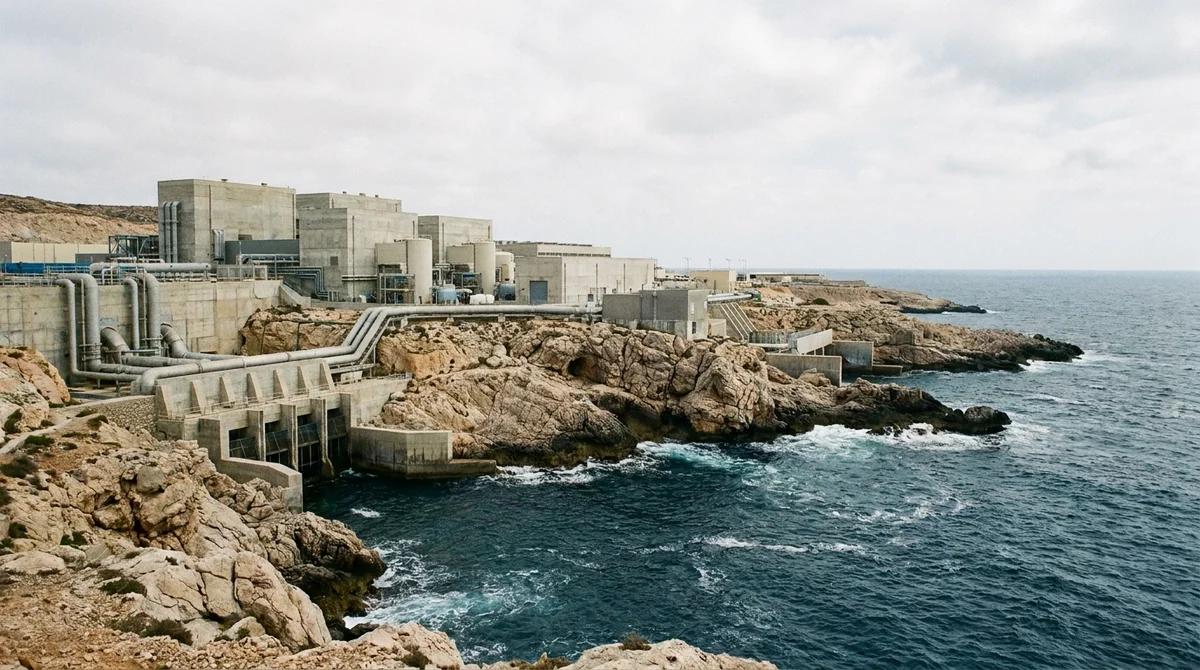
This process relies on reverse osmosis, which forces pressurized seawater through microscopic filters to strip away dissolved solids. To achieve this, facilities must intake large volumes of ocean water, pre-treat it with chemicals to prevent organic growth from clogging the membranes, and then apply high pressure.
Pushing water through these membranes requires highly specialized high-pressure pumps. Generating that pressure demands a constant, large supply of electricity.
Where it demonstrably works
Reverse osmosis has become dramatically more efficient. Desalinating a cubic metre of seawater took roughly 20 kilowatt-hours of electricity in 1980; the best commercial plants today do it in about 2.5 to 4, and the theoretical thermodynamic floor is close to 1 (Elimelech & Phillip, 2011). That efficiency gain, paired with a wealthy and energy-secure grid, is why Israel now meets most of its domestic water demand from a handful of large reverse-osmosis plants on its Mediterranean coast, and why Singapore treats desalination as one pillar of a deliberately diversified supply that also includes recycled wastewater and imported water.
Where the grid is clean and the economics work, desalination is not a false promise, it is a working, if expensive, part of the water supply.
The magic bullet myth and energy trade-offs
Techno-optimists frequently point to ocean filtration as the ultimate answer to global drought.
However, desalination fails as a global fix because its significant energy requirements compete directly with climate goals unless the plant is powered by renewables (Elimelech & Phillip, 2011). Currently, most global desalination capacity relies on fossil fuels, creating a vicious cycle. Burning coal or gas to create freshwater accelerates the atmospheric warming that caused the drought in the first place.
Even when connected to renewable grids, the sheer power demand competes with other critical electrification needs, like heating homes or charging transit networks.
Fact: Because of the energy requirements and pumping logistics, it is mainly viable for wealthy, energy-rich coastal areas, and it does little for inland drought zones.
Where this falls short
Removing salt from ocean water leaves behind a highly concentrated toxic byproduct.
For every liter of fresh drinking water produced, plants generate roughly 1.5 liters of hypersaline brine on average worldwide, which is often pumped directly back into the sea (Jones et al., 2019). This heavy, salty sludge sinks to the ocean floor, where it can smother marine ecosystems, destroy seagrass beds, and create localized ecological dead zones.
Furthermore, this brine is often mixed with the chemical anti-scalants and copper traces used during the pre-treatment phase. Managing this chemical load requires expensive diffuser pipelines that many regional governments cannot afford to build or maintain.
Geopolitical barriers and inland isolation
Geography strictly dictates who benefits from ocean filtration.
Moving water uphill is incredibly heavy and power-intensive, meaning that pumping desalinated water inland becomes economically impossible for most countries (World Bank, 2020). A coastal city in California or the Middle East might afford the infrastructure, but a landlocked agricultural region hundreds of kilometers away remains cut off from this supply.
This creates a geopolitical divide where wealthy coastal regions secure climate-resilient water supplies, while lower-income or inland regions face accelerating economic water scarcity. It is a highly localized luxury adaptation, not a global cure.
What to take away
Desalination is an engineering marvel that comes with severe physical and financial constraints.
- Modern reverse osmosis requires large amounts of electricity to force seawater through microscopic membranes.
- Relying on fossil fuels to manufacture water accelerates the very warming causing the drought.
- Facilities produce highly concentrated, toxic brine that threatens marine life when dumped back into the ocean.
- Because moving water inland is expensive, ocean filtration only solves coastal scarcity for wealthy regions.
- If you live near a coast, check whether your regional water utility's supply mix includes desalination and where its environmental report says the brine is discharged.
Watch how local governments in your region propose funding new water infrastructure over the next decade.
References
- Elimelech, M., Phillip, W.A. (2011). The Future of Seawater Desalination: Energy, Technology, and the Environment. Science. Source
- Jones, E., Qadir, M., van Vliet, M.T.H., Smakhtin, V., Kang, S. (2019). The State of Desalination and Brine Production: A Global Outlook. United Nations University Institute for Water, Environment and Health (UNU-INWEH). Source
- World Bank Group. (2020). The Economics of Water Scarcity and Infrastructure. World Bank Publications. Source