The Global Groundwater Depletion Cycle
Analyze the long-term ecological consequences of over-pumping slow-to-replenish underground aquifers when surface water fails.
Surface water is what we can easily see, the rivers, lakes, and reservoirs that visibly shrink during a drought. But beneath our feet lies a much larger, hidden reserve that human civilization relies heavily upon.
When the rains stop falling and the rivers run dry, agricultural mega-farms and sprawling cities turn to the dark depths below to keep the taps flowing. They treat the ground as an infinite reservoir.
What happens when we pump out underground water faster than it rains?
The slow-to-replenish savings account
Underground water is stored in aquifers: vast, porous layers of rock, gravel, and sand that hold water like a gigantic geological sponge. Some aquifers recharge relatively quickly from seasonal rain, but many of the world's largest are fossil aquifers.
These ancient reserves hold water that trickled down thousands of years ago. Pumping from them is not like scooping a bucket out of a flowing river; it is like withdrawing money from a savings account where nobody is making deposits (UN-Water, 2022). Once we pump this groundwater to the surface to spray on crops, it evaporates or runs off into the ocean. It does not go back into the deep sponge.
As surface droughts worsen due to climate change, we are steadily draining our ultimate buffer against famine. We are spending millennia of savings in a few short decades.
The ground physically collapses
When you drain the water out of a geological sponge, the sponge does not hold its shape. The water inside an aquifer physically supports the heavy layers of rock and clay above it.
As heavy industrial pumps extract water faster than it returns, the empty pores in the aquifer collapse under the weight of the earth above. This causes permanent land subsidence: the actual elevation of the land sinks (USGS, 2023).
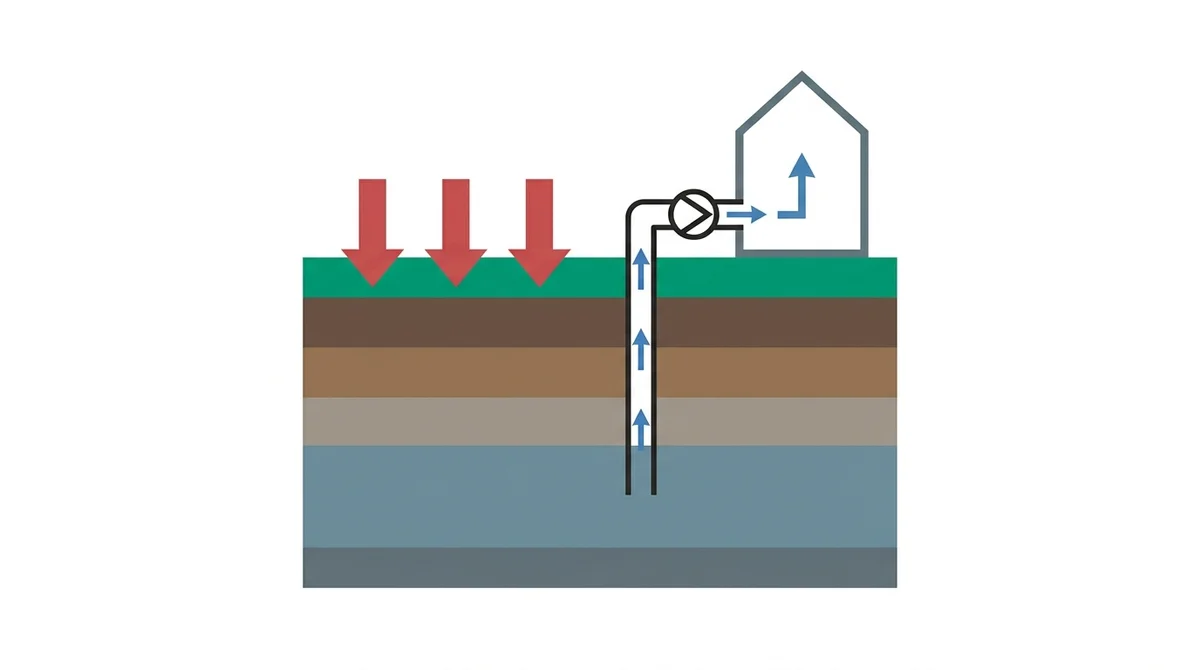
This is not a temporary dip. Once the fine-grained clay layers inside an aquifer compact under that weight, most of the lost storage capacity does not return on any timescale that matters to the people living above it (USGS, 2023). Even if extreme floods eventually soak the region, the underground storage tank has been permanently crushed. On the surface, this subsidence cracks building foundations, destroys highway infrastructure, and warps the gradient of municipal sewer pipes so waste no longer flows downhill.
The invisible coastal threat
For coastal regions, over-pumping triggers a different, equally serious consequence.
Fresh groundwater naturally flows outward toward the sea, maintaining pressure that pushes back against the heavy ocean saltwater. When coastal cities deeply over-extract their aquifers, they create an underground vacuum. With the freshwater pressure gone, ocean water is pulled inland and downward into the drinking supply.
Cities facing saltwater intrusion find themselves surrounded by ocean, sitting on top of poisoned wells, entirely reliant on importing water or building phenomenally expensive desalination plants (IPCC, 2022).
Helping nature recharge aquifers
This lesson has described aquifer depletion as a one-way process, and for the deepest fossil aquifers described above that is largely true. But not every aquifer behaves like a sealed vault.
Where the rock above is sandy or gravelly rather than clay, and where extraction is deliberately slowed, water levels can and do recover. Since the 1960s, engineers have scaled up managed aquifer recharge: diverting flood flows, treated wastewater, or seasonal rain into infiltration basins, recharge wells, and check dams so it soaks back down rather than running to the sea (Dillon et al., 2019).
Globally this now returns an estimated 10 cubic kilometres of water to aquifers every year, and adoption has grown by roughly 5 percent annually for six decades. That has not kept pace with the rate of global extraction, so managed recharge is a genuine mitigation rather than a fix, and it does nothing for aquifers whose clay layers have already compacted. The distinction that matters in practice is whether an aquifer's storage layers are still elastic, in which case recharge can help, or have already permanently compacted, in which case the storage loss described above is done.
What to take away
Over-reliance on groundwater is a quiet problem that permanently damages our resilience to climate shocks.
- Many large agricultural regions rely on fossil aquifers, which act like non-renewable savings accounts rather than flowing rivers.
- Extracting water too quickly causes permanent land subsidence, crushing the aquifer so it can never hold water again.
- Sinking land destroys surface infrastructure, snapping pipes and cracking foundations.
- In coastal areas, over-pumping creates a vacuum that pulls ocean water into the aquifer, causing irreversible saltwater intrusion.
- Look up whether your regional water agency runs or funds a managed aquifer recharge or groundwater sustainability plan, and whether it reports the basin's water table trend.
Next, we will shift from these physical systems to the human-built infrastructure that pumps, treats, and loses this precious resource.
References
- United Nations Water. (2022). Groundwater: Making the Invisible Visible. The United Nations World Water Development Report 2022. Source
- United States Geological Survey. (2023). Land Subsidence Cause by Groundwater Depletion. Source
- Intergovernmental Panel on Climate Change. (2022). Climate Change 2022: Impacts, Adaptation and Vulnerability. Source
- Dillon, P., Stuyfzand, P., Grischek, T., et al. (2019). Sixty years of global progress in managed aquifer recharge. Hydrogeology Journal. Source