Hidden Minerals in Everyday Electronics
Identify the critical minerals targeted by ocean miners and locate them within common household technology.
You probably interacted with rechargeable batteries before leaving the house today. From the lithium-ion cell keeping your smartphone alive to the power tools in the garage, modern life runs on portable energy. We rarely think about the physical ingredients packed inside these sleek cases until a device suddenly stops holding a charge.
Yet that hidden chemistry relies on a specific mix of metals scraped from the earth. As households transition toward renewable energy, the volume of these required metals is skyrocketing. Upgrading to a solar-powered home battery or swapping a gas car for an electric vehicle multiplies a household's demand for these materials.
What materials in everyday electronics are actually driving the controversial push to mine the deep ocean?
The chemistry powering your devices
To understand the global supply chain, you have to look inside the battery housing.
While lithium gets the most public attention, energy density relies heavily on cobalt and nickel, which stabilise the cell and pack more power into a smaller space. Without these specific elements, your smartphone would need to be twice as thick to last through the afternoon. Along with copper for wiring and manganese for structural stability, these metals form the physical backbone of modern consumer electronics.
These specific ingredients are classified globally as critical minerals (IEA, 2021). Because they are irreplaceable in current commercial battery chemistry, securing a steady supply of them has become a matter of national security and intense corporate competition.
The footprint of green upgrades
Scaling up our energy systems changes the math on mineral demand entirely.
A standard smartphone battery contains just a few grams of cobalt, but an electric vehicle battery requires kilograms, scaling up the material footprint exponentially (UNEP, 2023). The same applies to home energy systems. A household installing a domestic solar battery backup and purchasing a couple of e-bikes drastically increases its reliance on refined metals.
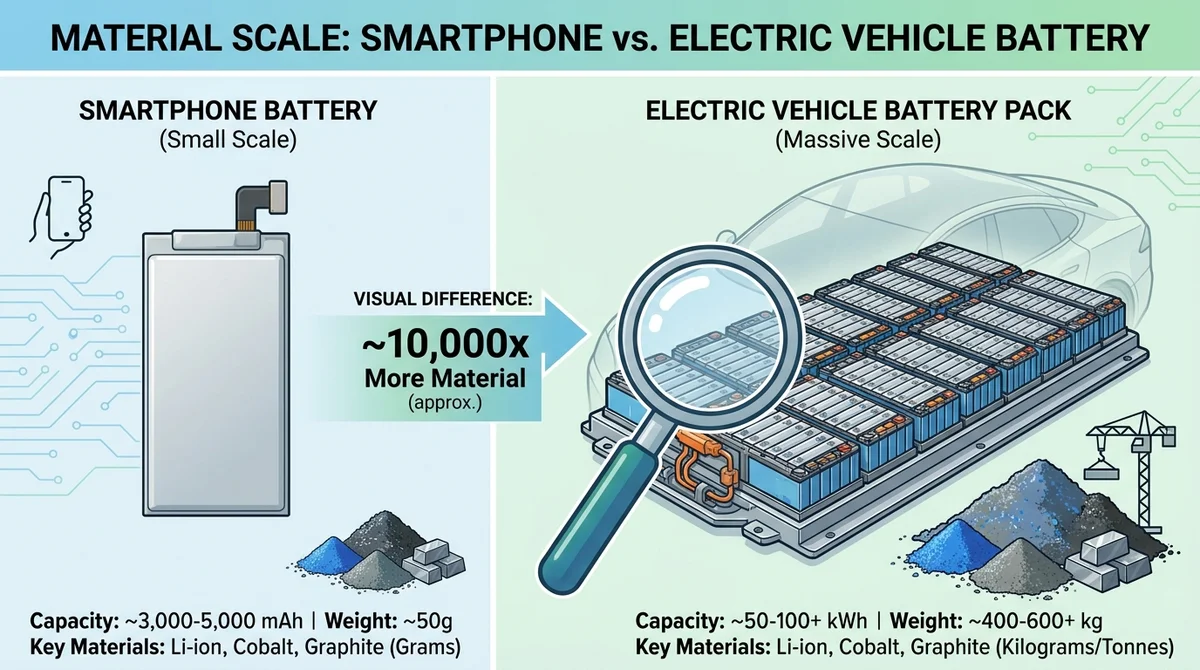
Because global climate targets rely on shifting away from fossil fuels, the demand for these specific materials is expected to surge over the coming decades. This immense volume requirement is what drives extraction companies to look for entirely new frontiers.
Why terrestrial supply chains are vulnerable
Currently, land-based mines supply all of our battery metals, but they face mounting limitations.
High-grade ore deposits on land are becoming harder to find. When companies discover a new site, the rock often yields less metal per tonne, meaning they must dig deeper and process more waste rock to get the same amount of refined material. Furthermore, these land-based operations are deeply consolidated. The vast majority of the world's cobalt is mined in the Democratic Republic of Congo, while nickel production is heavily centred in Indonesia (USGS, 2024).
When a supply chain is this concentrated, extreme weather, export bans, or geopolitical conflicts create severe mining bottlenecks. These bottlenecks cause price spikes that ripple directly to the consumer market, affecting the cost of everything from portable power stations to laptops. Finding a massive, untapped reserve outside of any single country's borders is the extraction industry's ultimate goal - which leads directly to the international seabed.
What to take away
The push for ocean mining is ultimately a story about the changing physical ingredients of everyday technology.
- Modern batteries rely heavily on cobalt, nickel, and copper to maintain their energy density.
- Switching to electric vehicles and home battery systems drastically increases a household's hidden material footprint.
- Because critical minerals are concentrated in just a few regions, their supply chains remain highly vulnerable to disruption.
Knowing which metals power your life makes it easier to understand why extraction companies are looking so urgently at the bottom of the ocean.