How Haber-Bosch doubled reactive nitrogen
Explores the early 20th-century scientific breakthrough that allowed humans to synthesize fertilizer and bypass natural limits.
At the dawn of the twentieth century, global agriculture was facing a terrifying mathematical reality. The human population was growing rapidly, but the world's supply of usable fertilizer was not. Farmers relied almost entirely on finite supplies of organic waste, manure, crop compost, and imported seabird guano, to replenish exhausted soils.
European scientists warned of an impending global famine. The natural nitrogen cycle, limited by the slow pace of soil bacteria, simply could not support the projected population.
We were physically running out of the nutrients required to grow food on a mass scale.
How did humans manage to break the natural nitrogen cycle in the first place?
Pulling bread from the air
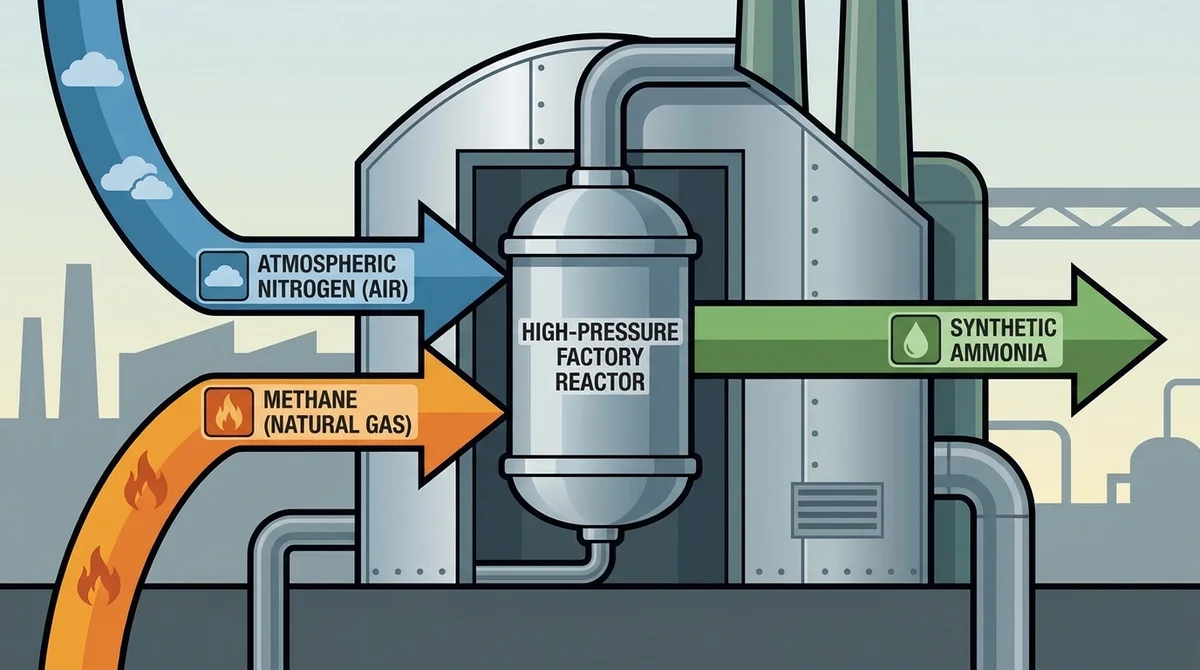
In 1909, a German chemist named Fritz Haber demonstrated a process that would fundamentally change the trajectory of human history. Working with engineer Carl Bosch, they developed an industrial mechanism to completely bypass the slow biological work of soil bacteria. The Haber-Bosch process synthesizes ammonia by forcing inert atmospheric nitrogen to bond with hydrogen under extreme conditions.
Because the triple bond of atmospheric nitrogen is so incredibly strong, the chemical reaction requires a staggering amount of energy. To snap the bond apart, the factories utilize steel reactors heated to roughly 400 to 500°C (750 to 930°F), applying pressures hundreds of times higher than the atmosphere at sea level.
This breakthrough meant humanity was no longer dependent on the finite biological limits of nature. We could pull the very building blocks of agriculture straight out of the sky, turning the air itself into the foundation for global food production.
Doubling the planetary flow
The scale at which we deployed this technology is difficult to comprehend. Before industrialization, the only reactive nitrogen entering the biosphere came from natural biological fixation and occasional lightning strikes. The planet had a stable, predictable flow of nutrients.
Today, human activity produces as much reactive nitrogen in factories as all natural terrestrial processes combined. Humanity has effectively doubled global nitrogen flows, injecting an unprecedented volume of reactive chemistry into the Earth system every single year (UNEP, 2019).
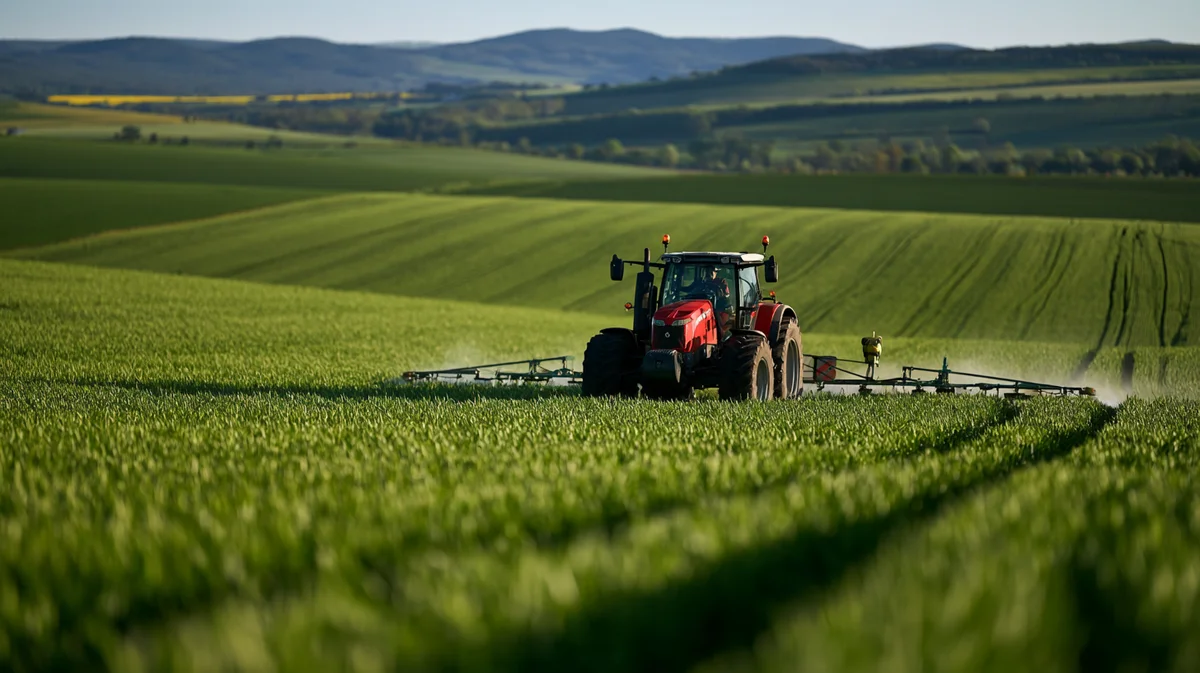
Annually, over 100 million tonnes of synthetic nitrogen fertilizer are manufactured globally. We spray this massive volume across corn, wheat, and rice fields, intentionally overriding the nutrient limits of the soils that support modern civilization.
Every year, factories churn out over 100 million tonnes of synthetic fertilizer. How has this immense industrial output shifted the balance of reactive nitrogen on Earth?
Industrial production accounts for roughly a quarter of the world's reactive nitrogen today.
Human activity now produces as much reactive nitrogen as all natural terrestrial processes combined.
Human factories have completely replaced natural biological fixation.
Correct
Humanity has effectively matched nature's output, doubling global nitrogen flows and injecting an unprecedented volume of reactive chemistry into the Earth system.
The fossil fuel tether
Pulling nitrogen from the air sounds like an almost magical, infinitely renewable process. The hidden catch lies in how the factory achieves those extreme temperatures and where it sources the hydrogen. Synthetic fertilizer relies deeply on fossil fuels, specifically natural gas, to fuel the chemical conversion (IEA, 2021).
In a modern fertilizer plant, methane (natural gas) serves two distinct purposes. First, vast quantities of it are burned simply to create the massive heat and pressure required inside the reactors. Second, the methane molecules themselves are stripped apart to provide the hydrogen atoms that ultimately bond with the nitrogen to create ammonia.
Because the Haber-Bosch process relies so heavily on burning natural gas for heat and breaking methane for hydrogen, fertilizer production is incredibly carbon-intensive. The manufacturing phase alone accounts for roughly 1 to 2 percent of total global carbon dioxide emissions.
When you account for the entire lifecycle, from the factory to the farm field where microbes convert excess nutrients into other greenhouse gases, synthetic nitrogen represents a massive, hidden climate footprint embedded directly in the global food supply.
This reality creates a direct, physical tether between global food security and the fossil fuel industry. While a sweeping agricultural landscape might look green and entirely natural, the crops growing there are essentially powered by ancient carbon pulled from underground.
A commercial farm advertises its grain as '100% solar-powered' because its tractors and barns run entirely on renewable electricity. If they still apply standard synthetic fertilizer, why is their claim physically inaccurate?
The factory uses coal to mine the raw atmospheric nitrogen out of the ground.
The nitrogen in the fertilizer physically blocks solar radiation from reaching the soil.
The fertilizer is manufactured using hydrogen atoms stripped from methane.
Correct
Even if the farm uses renewable electricity, standard synthetic fertilizer relies on natural gas as both a fuel and a hydrogen source, meaning the crop is largely powered by ancient carbon.
The population paradox
It is tempting to look at the severe ecological damage of synthetic fertilizer and demand an immediate, universal halt to its production. However, any realistic conversation about planetary boundaries must confront the sheer number of people this industry sustains.
Without the Haber-Bosch process, the Earth's natural nitrogen cycle could only produce enough food for roughly half of the current global population. Banning synthetic nitrogen outright would cause mass starvation, severely reducing global crop yields within a single growing season.
Because 8 billion people currently share the planet, the global goal cannot be simple elimination. Instead, the systemic challenge is optimization. We must figure out how to grow food with dramatically less fertilizer waste, transition to renewable hydrogen sources for manufacturing, and rethink what diets we choose to support.
Many environmental advocates want to fix the broken nitrogen cycle. Which pathway offers a realistic systemic approach to managing the damage caused by synthetic nutrients?
A
Transitioning to renewable hydrogen sources while dramatically reducing fertilizer waste.
B
Implementing a universal halt to industrial production to let natural soil microbes recover.
Correct
Because synthetic fertilizer sustains roughly half the world's population, we cannot simply eliminate it. The solution requires optimizing application and finding greener manufacturing methods.
What to take away
The invention of synthetic fertilizer solved an impending starvation crisis, but it permanently tethered our food supply to fossil fuels and broke a natural planetary limit.
- The Haber-Bosch process uses extreme heat and pressure to pull nitrogen from the air and convert it into synthetic ammonia.
- Human activity now produces as much reactive nitrogen as all terrestrial nature combined, doubling the flow of nutrients on Earth.
- The process relies heavily on natural gas, both as a fuel for the reactors and as the source of hydrogen atoms.
- Because synthetic fertilizer feeds half the world, the environmental solution is precision and optimization, not an outright ban.
Next, we will look at exactly what happens to the surrounding environment when all this synthetic nitrogen inevitably washes off the farm.