How regional nitrogen caps force industry change
Evaluate the effectiveness of nitrogen budgets and Scope 3 emissions tracking in the food industry.
For most of the twentieth century, agricultural policy had one primary goal: grow as much food as possible. Governments rewarded farmers for maximum yield, regardless of how much chemical fertilizer washed into the local river.
But as the ecological bill for those practices comes due, the legal landscape is shifting. From European courtrooms to global corporate boardrooms, new limits are being placed on the invisible flow of nutrients leaving agricultural land. Regulators and supply chains are finally treating nitrogen runoff not as an inevitable byproduct, but as a heavily restricted pollutant.
What is actually forcing big agriculture companies to change how much fertilizer they use?
Setting a legal limit on runoff
The most direct way to stop nitrogen pollution is to simply make it illegal to exceed a certain limit in sensitive ecological areas.
Regulators are increasingly establishing a nitrogen budget for specific watersheds or agricultural zones (EEA, 2022). A budget calculates exactly how much reactive nitrogen the local environment can absorb safely. If a farm's inputs (such as synthetic fertilizers and animal manure) exceed its outputs (the nitrogen physically removed inside harvested crops), the surplus is assumed to have leaked into the environment. When regions exceed their collective budgets, governments step in to halt agricultural expansion or enforce mandatory reductions.
In places like the European Union, strict directives are forcing national governments to fundamentally restructure their farming sectors to comply with these ecological limits. Instead of subsidising the purchase of more fertilizer, state funds are slowly being redirected to reward sustainable soil management practices, like planting cover crops to trap excess nutrients before they reach rivers.
Corporate accountability and Scope 3 emissions
Regulation is not the only force driving change; intense pressure is also cascading down through global food supply chains.
Large multinational food and beverage corporations frequently make public pledges to achieve "net-zero" climate impacts. To do this credibly, they cannot just measure the energy used in their own processing factories or corporate offices. They must also rigorously account for Scope 3 emissions, which are the indirect climate impacts generated by their external suppliers (WRI, 2021).
For a global food company, the vast majority of their carbon footprint actually comes from the nitrous oxide emitted by the independent farms growing their raw ingredients. If a major cereal brand wants to meet its climate goals, it must force the thousands of independent farmers supplying its wheat to optimise their nitrogen use. This pushes the burden of nitrogen tracking down the supply chain, turning strict fertilizer efficiency into a mandatory requirement for doing business with major commercial buyers.
The friction of sudden policy shifts
While these regional caps and tracking requirements are necessary to protect planetary boundaries, they create immense economic friction on the ground.
A government suddenly bans all synthetic fertilizer use in a major farming region.
The government redirected subsidies to reward sustainable soil management practices like planting cover crops.
The abrupt policy restricts farmers from reaching the maximum yields required to service their massive equipment loans.
Multinational food corporations begin tracking the indirect greenhouse gases generated by their external suppliers.
Farmers organize massive protests, blocking highways with their tractors.
Correct
Farming is often a low-margin, high-debt business. When sudden environmental regulations restrict the yields farmers need to pay off their loans, it creates intense transition friction, leading to rural pushback if no financial support is provided.
Farming is a low-margin business heavily reliant on debt. A farmer might hold massive loans for land and equipment, calculated on the assumption of maximum crop yields. When a government suddenly enforces a strict nitrogen cap, it restricts a farmer's ability to guarantee those high yields. This creates intense transition friction, often sparking widespread rural protests (Nature Food, 2023).
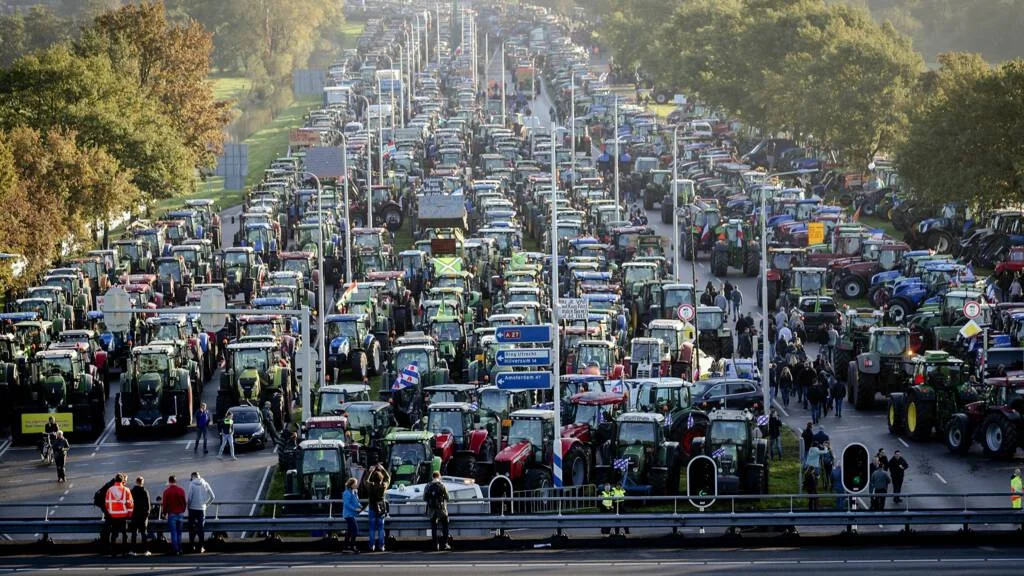
A clear example of transition friction occurred in the Netherlands, where courts mandated severe cuts to nitrogen emissions to protect nature reserves. The sudden policy shift threatened thousands of livestock and agricultural operations, leading to massive protests.
The standoff demonstrated that environmental policies can stall entirely if they are not paired with robust financial transition funding for the affected workers.
If aggressive nitrogen limits are not paired with robust financial transition funding, they threaten the immediate livelihoods of communities.
The challenge for policymakers is figuring out how to rapidly scale down synthetic inputs without bankrupting the families who built their businesses around the old, high-yield rules.
The transition requires buying out high-polluting farms, subsidising new precision equipment, and compensating growers for temporary yield drops while their soil recovers.
What to take away
You now see how legal and corporate mechanisms are forcing the agricultural sector to rein in its nitrogen footprint.
- Regional nitrogen budgets cap how much excess fertilizer is allowed to leak into specific ecosystems.
- Governments are slowly shifting subsidies away from chemical inputs toward sustainable soil practices.
- Food corporations track Scope 3 emissions, forcing their supplier farms to reduce nitrous oxide pollution.
- Sudden fertilizer regulations can threaten farm livelihoods unless paired with financial transition support.
In the final module, we will connect these macro-level industry shifts directly to your everyday grocery choices.