
How reactive nitrogen suffocates marine life
Detail the aquatic crisis of nutrient pollution and explain how farm runoff creates lifeless zones in the ocean.
When heavy rain falls on a freshly fertilized field, the runoff looks completely harmless. It just looks like muddy water flowing into a drainage ditch.
In reality, that water is carrying dissolved fertilizer. Synthetic nitrogen is engineered to be highly soluble so plant roots can absorb it instantly. That same solubility means whatever the crops do not soak up washes away easily, beginning a long journey toward the sea.
How does fertilizer washing off a farm end up killing fish in the ocean?
The journey from farm to coast
Nitrogen pollution rarely stays local. Once it enters a drainage ditch, it moves into streams, then rivers, and eventually flows into coastal bays and open oceans.
A classic example is the Mississippi River basin. It drains millions of acres of farmland across the central United States. When all that unabsorbed agricultural nitrogen funnels into the Gulf of Mexico, it delivers a massive artificial nutrient spike to coastal waters (UNEP, 2019). This sudden delivery of plant food sets off a biological chain reaction that fundamentally alters the aquatic ecosystem.
The coastal waters are naturally balanced to support a specific food web. When a massive dose of reactive nitrogen arrives, the most basic organisms in the water react first.
The mechanism of an algae bloom
The sudden influx of nitrogen acts exactly like it does on land: it makes plant life grow at an unnatural speed.
In the ocean, microscopic algae and phytoplankton absorb the nitrogen. This triggers a massive, rapid reproduction cycle known as eutrophication. The surface of the water quickly becomes choked with thick, green or red layers of algae.
While an algae bloom might look like a thriving ecosystem from above, it is actually the beginning of an ecological collapse. The thick mat of algae blocks sunlight from reaching deeper underwater plants, killing off the foundational vegetation that many marine species rely on for food and shelter.
But the true devastation occurs not when the algae grows, but when it dies.
What is the immediate biological reaction when a large dose of agricultural nitrogen enters an ocean ecosystem?
A
It directly poisons and kills most of the native fish.
B
It triggers a rapid and massive reproduction cycle in microscopic marine plants.
C
It immediately strips the surrounding water of dissolved oxygen.
D
It blocks surface sunlight by killing off floating vegetation.
Correct
When reactive nitrogen reaches the ocean, it does exactly what it does on farmland: it acts as a powerful fertilizer, causing microscopic algae and phytoplankton to reproduce at unnatural, excessive speeds.
The biological oxygen demand
Algae blooms are intense but short-lived. When the millions of organisms run out of nutrients, they die off rapidly and sink to the ocean floor.
This massive graveyard of organic matter provides an unlimited feast for deep-water bacteria. As these bacteria consume the dead algae, they multiply exponentially. This bacterial feast creates a massive biological oxygen demand, meaning the microbes strip the surrounding water of dissolved oxygen to fuel their digestion (FAO, 2022).
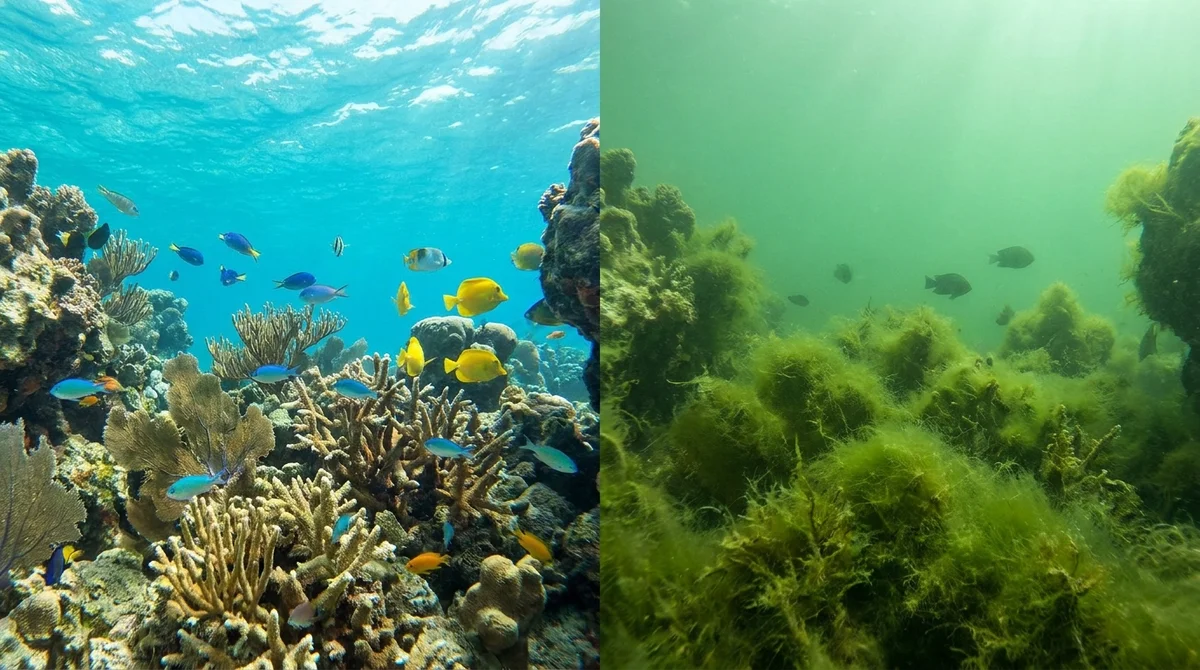
Marine life requires dissolved oxygen to survive. When the oxygen levels plummet, the water becomes a hypoxic zone. Mobile creatures like fish and sharks will quickly flee the area. However, bottom-dwelling species like crabs, clams, and young fish cannot escape in time. They simply suffocate.
This process creates what marine biologists call hypoxic dead zones: massive swaths of the ocean where almost no marine life can survive.
Comparing chemical and physical pollution
Ocean pollution is often visualized through the lens of physical waste.
The ocean plastic crisis gets significant public attention because a plastic bottle floating on the waves is visible and tangible. Nutrient pollution, by contrast, is an invisible chemical shift. You cannot easily photograph dissolved nitrogen.
Yet, in terms of sheer biological disruption, chemical dead zones represent a much more immediate threat to marine biodiversity than physical debris. A dead zone can wipe out an entire regional fishery in a matter of weeks. The Gulf of Mexico dead zone, for instance, grows every summer to an area roughly the size of a small country, effectively killing millions of marine organisms (NOAA, 2023).
Solving this aquatic crisis requires looking inland. The solution does not lie in filtering the ocean, but in preventing the excess nitrogen from leaving the farm in the first place.
Why does nutrient pollution pose a faster, more catastrophic threat to a local coastal ecosystem than physical plastic debris?
A
A nutrient-induced chemical shift can completely wipe out a regional fishery in a matter of weeks.
B
Dissolved nitrogen physically tangles and traps millions of marine organisms every summer.
Correct
While plastic pollution is highly visible, the invisible chemical shift of a dead zone causes immediate biological collapse, suffocating millions of organisms in a very short timeframe.
What to take away
You now understand how an invisible agricultural chemical transforms coastal ecosystems.
- Soluble nitrogen easily washes from farmland into river systems and coastal waters.
- This nutrient spike triggers eutrophication, causing massive and unsustainable algae blooms.
- When the algae die, decomposing bacteria strip oxygen from the water, creating lifeless hypoxic zones.
- While less visible than ocean plastic, nutrient runoff causes immediate and catastrophic damage to local marine biodiversity.
Next, you will look at how this same invisible chemical escapes into the atmosphere and accelerates global warming.