How precision agriculture limits fertilizer waste
Analyze how precision agriculture tools optimize nitrogen application and reduce environmental leakage.
For decades, the standard approach to fertilising a commercial field looked a lot like painting a wall with a wide roller. You estimate the total area, mix up a uniform batch of chemicals, and coat everything evenly. If a few spots get too much, the assumption is that the plants will eventually absorb it.
But soil is not a flat wall. A single hectare can contain dozens of micro-environments with different moisture levels, slopes, and historical nutrient retention. When nitrogen is applied uniformly across uneven terrain, the excess does not just sit there waiting for roots to find it. It washes away into the local water during the next rainstorm or vaporizes into the atmosphere as a potent greenhouse gas.
Can farmers use less fertilizer without losing their crop yields?
Targeting nutrients exactly where they are needed
Technology is shifting agriculture away from blind, uniform spraying toward a highly targeted approach.
By adopting precision agriculture, farmers use spatial data to match fertilizer application to the exact needs of specific plants. Instead of treating a 400-hectare (1,000-acre) field as a single uniform unit, growers divide it into tiny management zones based on real-time feedback.
Drones equipped with multispectral cameras fly over the crop canopy to assess plant health, identifying exact patches where leaves are yellowing from nutrient deficiency. At the ground level, digital soil sensors measure real-time moisture and chemical composition across the terrain (USDA ERS, 2023).
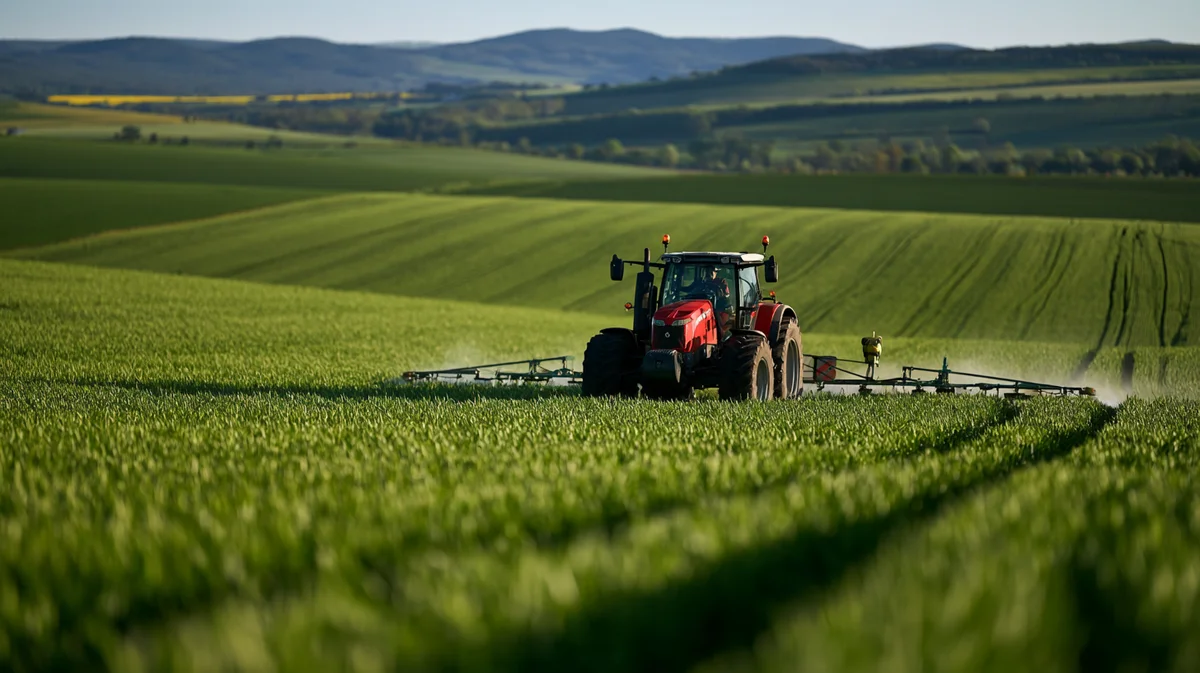
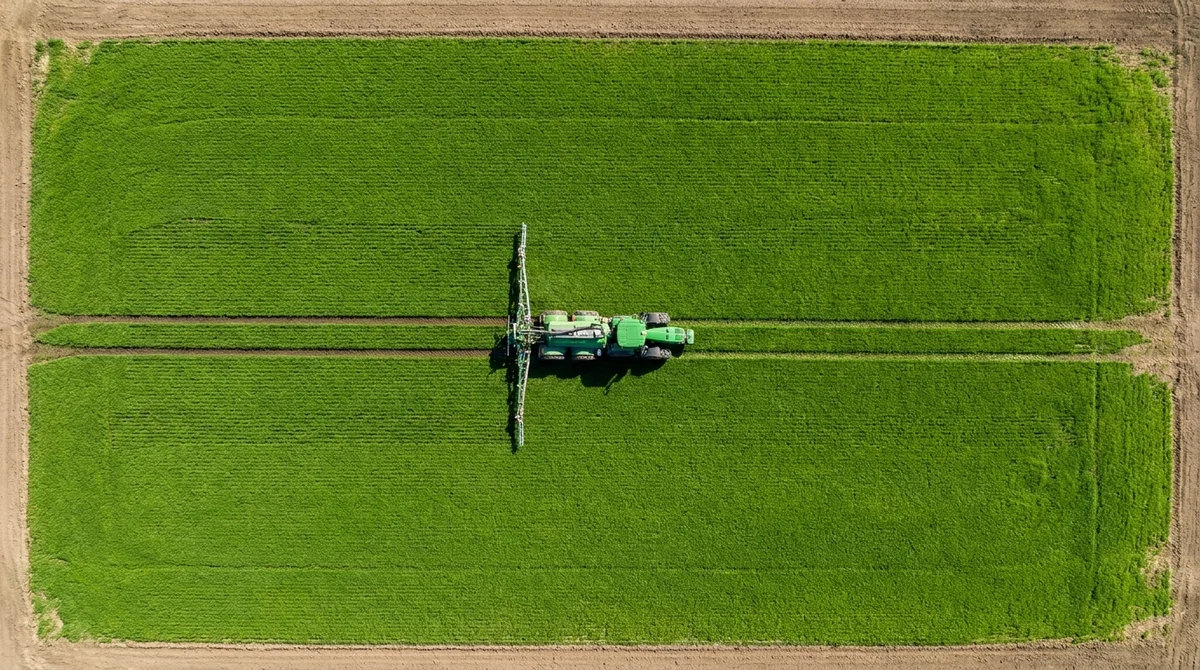
This data feeds directly into the tractors applying the chemicals. Variable rate technology allows modern machinery to adjust the flow of fertilizer second by second as it drives across a field. If the tractor crosses a nutrient-rich dip in the landscape, it automatically scales back the spray. If it hits a degraded hill, it increases the dose. This prevents over-application in areas that simply cannot absorb more nitrogen.
The importance of timing in the growth cycle
Knowing where to put nitrogen is only half the battle; knowing when to apply it is just as critical to preventing environmental pollution.
Plants do not absorb nutrients at a constant rate. A young corn seedling requires very little nitrogen, but as it enters its rapid growth phase weeks later, its demand spikes dramatically. If a farmer dumps the entire season's fertilizer on the field before planting, much of that nitrogen will sit exposed to rain and soil microbes long before the roots are large enough to take it in.
What happens when a field receives its entire seasonal fertilizer load while the crop is just sprouting?
A
The excess nitrogen sits in the soil and is highly susceptible to being washed away.
B
The seedlings absorb the bulk of the nutrients immediately to fuel future rapid growth.
C
Soil microbes safely store the chemical inputs until the rapid growth phase begins.
D
Variable rate technology automatically stops the chemicals from touching the young roots.
Correct
Because seedlings need very little nitrogen, applying massive doses early leaves the chemicals exposed to rain and atmospheric conversion before the roots can use them.
To solve this, farmers use split application to divide the total fertilizer load into smaller, timed doses. Tractor-mounted machinery driven by GPS can now inject liquid nitrogen directly into the root zone just as the plant enters its peak demand phase (Agronomy Journal, 2021). By aligning the chemical input with the natural biological uptake pattern, less nitrogen is left vulnerable to runoff or atmospheric conversion.
Where the precision model falls short
While data-driven farming sounds like a perfect technological fix to the nitrogen boundary, it comes with significant structural trade-offs.
The equipment required for this level of detailed mapping, including specialised drones, autonomous tractors, and proprietary software subscriptions, requires massive upfront capital. Because these tools are expensive, they heavily favour large corporate operations with deep financial reserves over small or mid-sized family farms (Nature Sustainability, 2022).
How does precision technology interact with the biological health of the farm?
A
It fundamentally transitions the land toward self-sustaining ecological health by eliminating synthetic nitrogen.
B
It optimizes a chemically dependent system but does not restore the soil's natural ability to cycle nutrients.
Correct
Data-driven farming makes applying synthetic fertilizer much more efficient, but it does not replace the need for those inputs like restorative biological practices do.
This financial barrier drives agricultural consolidation, as smaller family farms are bought out by larger entities that can afford the efficiency upgrades. In many regions, the push for high-tech environmental efficiency actually accelerates the loss of independent rural livelihoods.
Precision agriculture focuses almost entirely on optimising synthetic inputs rather than rebuilding the soil's natural capacity to cycle its own nutrients. It is a highly efficient way to manage a chemically dependent system, reducing waste and saving money. However, because it still relies on applying Haber-Bosch nitrogen, it does not fundamentally transition the farm toward self-sustaining ecological health.
Furthermore, precision technology only limits the waste of synthetic fertilizer; it does not eliminate the need for it. As long as crops are grown continuously without restorative practices like crop rotation or cover cropping, the baseline demand for reactive nitrogen remains unsustainably high.
A region introduces strict laws requiring all farms to use modern technology to limit nitrogen waste. Based on the lesson, what is the most likely social consequence for the region?
Small farms will abandon chemical fertilizers and adopt restorative cover cropping instead.
Larger businesses will purchase the smaller farms that cannot afford the expensive new equipment.
The upfront capital costs will be offset by the need to buy fertilizers
Correct
The high upfront costs of precision technology heavily favor well-funded corporate entities, driving the consolidation of smaller independent rural livelihoods.
What to take away
You now understand how data and technology are changing the way synthetic nutrients are applied to large-scale farms.
- Traditional uniform spraying wastes massive amounts of nitrogen on soil that does not need it.
- Precision agriculture uses sensors and drones to target specific micro-zones, reducing chemical runoff.
- Split application matches the timing of fertilizer to the plant's growth stage, preventing early waste.
- The high cost of this technology often forces smaller farms to consolidate into larger corporate operations.
Next, we will look at how this hyper-optimised system in wealthy countries contrasts with severe fertilizer shortages elsewhere in the world.
References
- United States Department of Agriculture Economic Research Service. (2023). Precision Agriculture in the Digital Era. Source
- American Society of Agronomy. (2021). Optimizing Nitrogen Fertilizer Application for Environmental Sustainability. Source
- Nature Sustainability. (2022). The socioeconomic trade-offs of precision agriculture adoption. Source